





BLUE VINYL WINS CINEMATOGRAPHY AWARD IN DOCUMENTARY COMPETITION
AT 2002 SUNDANCE FILM FESTIVAL AND WILL BROADCAST ON HBO SUNDAY MAY 5th
Directed By Judith Helfand and
Daniel B. Gold
Produced by Daniel B. Gold, Judith Helfand and Julia D. Parker
A Toxic Comedy Look at Vinyl, The World's Second Largest Selling Plastic.With
humor, hope and a
piece of vinyl siding firmly in hand, Peabody Award-winning filmmaker
Judith Helfand and co-director Daniel B. Gold travel from Helfand’s
hometown to America’s vinyl manufacturing capital and beyond in search
of answers about the nature of polyvinyl chloride (PVC). Her parents’
decision to “re-side”
their house with this seemingly benign cure-all for many suburban homes
turns into a toxic odyssey
with twists and turns that most ordinary homeowners wouldnever dare to
take. The result is a humorous
but sobering and uniquely personal exploration of the relationship between
consumers and industry in the feature-length documentary BLUE
VINYL, which won the cinematography award in
the documentary competition at the 2002 Sundance Film Festival and will
broadcast on HBO Sunday May 5th.
Early in the film, Helfand, who readily admits that her last science class
was tenth-grade biology, invites two environmental experts from Greenpeace
over to her parents’ vinyl-sided home in Long Island to give her
and her dad Ted, a crash course on PVC. “Granted, these guys were
biased in favor of saving the planet and its inhabitants,” Helfand
quips, acknowledging
the inevitable bias of advocacy groups, “but I didn't have a problem
with that.” But, she soon augments her Greenpeace education with
more revelations
about vinyl from people such as Billy Bagget—an independent lawyer
in Louisiana who has spent the last decade piecing together a conspiracy
case against 29 of the largest PVC-producing chemical companies in the
world. From Bagget’s office in Lake Charles, Louisiana, the film
travels to Venice, Italy, where 31 executives from a PVC-producing company
are in the midst of a trial, personally accused of manslaughter in the
deaths of their employees and polluting the Venice Lagoon. (All of whom
were subsequently acquitted.)
What makes BLUE VINYL
unique is the balance of humor and horror, facts and anecdotes, and the
face off between cynicism and hope. Helfand’s character—and
the overall attitude of the film—never shies away from having a point
of view. Although the film reveals a complex web of alleged corporate
conspiracies and the tragic loss of human life from chemical exposure,
BLUE VINYL also
poses a refreshingly simple question: “Is it possible to make products
that never hurt anyone at any point of their life cycle—when manufactured,
when used, or when disposed of?” With this reasonable question, Helfand
turns her attention to her parents' modest, vinyl-sided home, where she
attempts to convince her mother and father, Florence and Ted, to take
the vinyl off the house if she can find a safe—throughout the entire
course of its lifecycle—and affordable alternative that fits in with
the neighborhood.
People often grow numb at the suggestion of the next
toxic threat to fret about, so BLUE VINYL
was made to transcend the expected. Never lingering on the fear of what
might be lurking in our chemically infused environment, Helfand leads
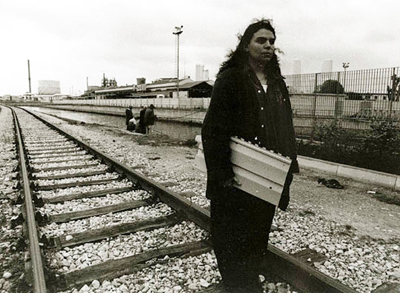
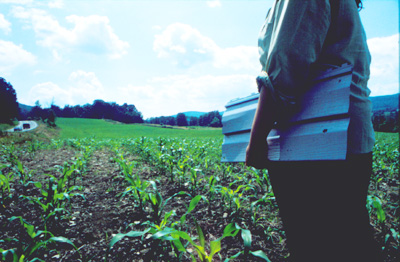
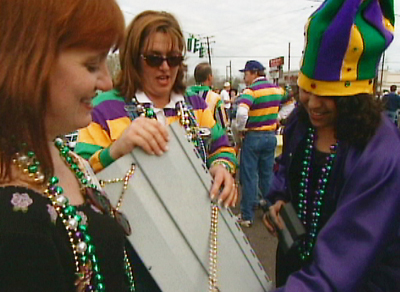
the audience on an international journey using a scrap of blue vinyl siding
left over from her parents' renovation as a calling card and conversation
starter. The film's quirky, fun and irreverent style—coupled with
its clear mission for environmental health and justice—uniquely places
it at the nexus between the worlds of entertainment and corporate accountability.
Among those people featured in BLUE VINYL
are:
• Ted and Florence Helfand -
- Judith’s parents are unsuspecting inspirations for the film after
they decide to put embossed, blue vinyl siding on their house – in
an effort to spruce it up for its pending sale and so they wouldn’t
have to ever paint it again.
• Diane Prince -
Diane is a resident of Mossville/Lake Charles, Louisiana who lives across
the street from the massive Condea Vista plant. Stricken with cancer,
she believes it was caused by the by-products discharged from the plant’s
burned chemicals and airborne pollutants.
• Billy Baggett -
Indefatigable attorney Baggett represents not only Lake Charles PVC workers
and their widows, but also a growing number of affected vinyl workers
and families throughout the U.S. Baggett patents the Transcenic Camera—an
ingenious 360 degree multi-camera contraption that he uses to document
the plaintiffs' workplace.
• Elaine Ross -
Ross is a widow whose husband suffered a slow and agonizing death after
working with vinyl chloride in the Conoco plant for 23 years.
• Ampelio Magro
- Magro is a surviving plant worker who lost his ability to speak from
cancer of the larynx and now uses a vibrating voice box.
• Patrick Hayes -
A “green” builder from the bay area in CA whom Helfand met on
her quest and agrees to come back to LI to help pitch her parents on finding
an alternative to vinyl siding. While there he sleeps in a tent and fixes
her parents' TV antenna.
• Dr. Caesare Maltoni -
The late pioneering Italian scientist Dr. Maltoni performed ground breaking
studies linking small amounts of vinyl chloride exposure to cancer in
laboratory animals. Maltoni urged the industry to recognize the predictive
nature of his results for PVC workers, but the vinyl industry did not
heed his warnings until workers started dying from the identical cancer
found in his laboratory animals.
• Dr. Paul W. Brandt-Rauf -
is a tenured Professor of Public Health and Director of Occupational and
Environmental Medicine at Columbia University in New York City. He's conducting
gene studies on people working with PVC at the current maximum exposure
levels and below. He is finding mutations that suggest what the vinyl
industry considers safe just might not be. Over 25 years ago, when permissible
occupational exposure to vinyl chloride was 500 times higher than is allowed
today, workers got malignant tumors with very specific gene mutations.
Today, Dr. Brandt Rauf is finding the same type of mutations quietly occurring
in the genes of PVC workers who feel healthy and believe their workplace
to be safe. Nobody knows if these mutations will result in life threatening
cancers, but Dr. Brandt- Rauf says it is quite possible.
• Dr. William F. Carroll Jr. - A
spokesperson for The Vinyl Institute, Vice President of Occidental Chemical
Corp., former adjunct industrial professor of Chemistry at Indiana University,
and former executive of the Chlorine Chemistry Council. Dr. Carroll is
the spokesperson designated to speak on camera when Helfand requests an
interview with The Vinyl Institute - a trade association dedicated to
the protection and promotion of PVC. During the interview, Carroll skillfully
delivers the industry's position.
BLUE VINYL is the second collaboration for Gold
and Helfand -- herself a cancer survivor, who underwent a hysterectomy
at 25 after contracting a rare form of cervical cancer due to her mother's
ingestion of the drug DES, a synthetic estrogen that was supposed to prevent
miscarriage. Along with Gold, Helfand chronicled that period in her life,
exploring the personal impact of toxic chemical exposure on her relationship
with her mother -- in her lauded documentary, "A Healthy Baby Girl"
(Sundance 1997) which garnered her a Peabody Award for excellence in journalism
and public education. A sequel of sorts, BLUE
VINYL picks up essentially where A HEALTHY BABY
GIRL left off in front of the Helfand's house as they are putting up the
blue vinyl siding. Who knew?
BLUE VINYL is
a Toxic Comedy Picture, directed by Judith Helfand and Daniel B. Gold;
produced by Daniel B. Gold, Judith Helfand and Julia D. Parker. Edited
by Sari Gilman, Director of Photography, Daniel B. Gold; Senior Creative
Advisor Michelle Ferarri, Animation by Emily Hubley, Original Music by
Marty Ehrlich & Sam Broussard, Steven Thomas Cavit, Terry Dame, Four
Piece Suit. Community outreach and education is being designed and coordinated
by Working Films.
Tom Chen and Winston Emano
Phone: 435.649.7000
Cell: 323.252.5568
Cell:310.739.0946
e-mail: tom.chen@tcdm-associates.com
or wemano@tcdm-associates.com
Producers Rep:
Next Wave Films
2510 7th Street, Santa Monica, CA 90405
Contact Person: Peter Broderick
Phone: 310.392.1720
Fax: 310.399.3455
Website: www.nextwavefilms.com
E-mail: launch@nextwavefilms.com
LEGAL NOTICE:
All copy and artwork in this site are strictly for the
members of the press and editorials. They may not be used for advertising
and other types of program or service promotion. ALL MATERIALS ARE FOR
EDITORIAL USE ONLY. PLEASE ALSO NOTE THE MANDATORY PHOTO CREDITS.